Scientists studying chimpanzees in Guinea have seen evidence of long-term and recurrent ingestion of ethanol by apes.
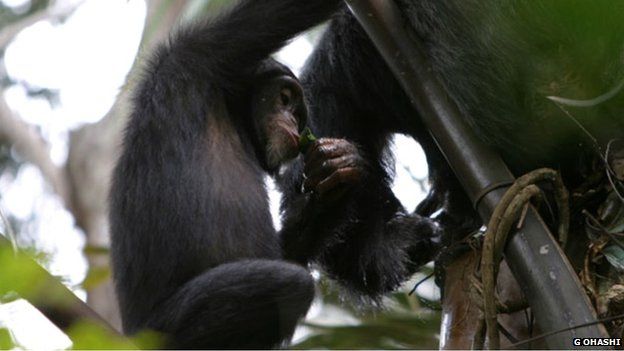
The 17-year study recorded chimps using leaves to drink fermented palm sap.
Some drank enough alcohol to produce "visible signs of inebriation".
The study - published in the journal Royal Society Open Science - revealed their tipple of choice is naturally fermented palm wine, produced by raffia palm trees.
Opportunistic Drinking
In the Bossou area of Guinea, where this research took place, some local people harvest "palm wine" from the trees - tapping them at the crown, and gathering the sap in plastic containers, which they collect in the mornings and evenings.
Researchers
working in the area had already witnessed chimpanzees climbing the
trees - often in groups - and drinking the naturally fermented palm sap.
The chimps used drinking tools called leaf sponges - handfuls of
leaves that they chew and crush into absorbent sponges, dip into the
liquid and suck out the contents.
To work out the extent of the
animals' indulging, the scientists measured the alcohol content of the
wine in the containers and filmed the chimps' "drinking sessions".
The
research team, led by Dr Kimberley Hockings from Oxford Brookes
University and the Centre for Research in Anthropology in Portugal,
worked out that the sap was about 3% alcohol by volume.
"Some
individuals were estimated to have consumed about 85ml of alcohol," she
said, "the equivalent to 8.5 UK units [approximately equal to a bottle
of wine]".
"[They] displayed behavioural signs of inebriation, including falling asleep shortly after drinking.
"On another occasion after drinking palm wine, one adult male chimpanzee seemed particularly restless.
"While
other chimpanzees were making and settling into their night nests, he
spent an additional hour moving from tree to tree in an agitated manner.
Again pure speculation, but it's certainly something we would like to
collect further data on in the future," the researcher told BBC News.
Alcohol
can be toxic, and although there have been unconfirmed anecdotes of
non-human primates consuming it in the wild, this is the first time that
researchers have recorded and measured voluntary alcohol consumption in
any wild ape.
In addition, chimpanzees' apparent taste for a
tipple adds to an evolutionary story about humans' common predilection
for alcohol. Another recent study by Matthew Carrigan, from Santa Fe
College in the US, showed that humans and African apes shared a genetic
mutation that enabled them to effectively metabolise ethanol.
Prof
Richard Byrne, an evolutionary biologist from the University of St
Andrews, commented that the evolutionary origin of that gene could be
that it "opened access to good energy sources - all that simple sugar -
that were accidentally 'protected' by noxious alcohol".
"And presumably, whatever its evolutionary origin, it is that adaptation which makes me able to enjoy a good malt," he added.
Dr
Catherine Hobaiter, from St Andrews University, said: "It would be
fascinating to investigate the [behaviour] in more detail: do chimps
compete over access to the alcohol? Or do those who drank enough to show
'behavioural signs of inebriation' have a bit of a slow day in the
shade the next morning?"
Dr Hobaiter added: "Even after 60 years of studying [chimpanzees], they are constantly surprising us."

No comments:
Post a Comment